Meet Bianca Harrington
Reading time: 4 mins
Drawing inspiration from everyday moments, Bianca's work captures subtle symbols and fleeting sparks of awe hidden in daily life. Join us in conversation with Bianca as she reflects on her journey through textiles and millinery, studying in London, and her plans for the future.

Q: Tell us about your journey to becoming an artist.
A: Making and creating is a way of life for me. I've always been a maker and artist in one way or another. My Mum is also a textile artist so I’ve grown up sewing, making jewellery and constantly trying out new arts and crafts. As a kid I would visit maker markets most weekends with my Mum to sell at or browse.
I studied jewellery making in the beginning and then moved to London in my early 20s where I studied at what is now Morley College. I also worked as a milliner for some of the world’s greatest Milliners. Upon moving back to Australia I started taking lessons in botanical illustration and printmaking over 10 years ago which evolved into the work I do today! That’s the very short version!

Q: Your background in textiles and millinery - how do these disciplines influence your artistic practice?
A: Millinery is a specialised art form in which you learn how to use and manipulate such varied media, from textiles, yarns, straws, felts, plastic, feathers etc. essentially nothing is off limits; the only limit is your imagination. It's a particular skill to learn how to translate an often abstract idea into a sculptural 3D form that looks compositionally balanced from all angles that then must stay in place on a moving subject! I learnt a lot from millinery. It certainly stretched my brain creatively. Also working with established London Milliners taught me how a studio practice runs.
Merging scissors with paint and paper cut outs has definitely been influenced by my previous life as a milliner. Arranging cut shapes also feels more akin to balancing a millinery piece than straight up painting. I feel my work has an element of design due to my millinery and textile printing background.
My textile printing work shows up very obviously via the flattened motifs that are characteristic of my block printed textile designs. I sometimes sneak in a quilt panel too, as it’s another small part of my creative vocab. All of my disciplines feed into one another constantly.

Q: You spent time living and studying in London - how did that experience shape you creatively?
A: London really reinforced that creativity already pulsing through my veins. I was surrounded by creatives. Musicians, Poets, Designers, Writers, Stylists, Photographers, Artists, Performers, Crafters and more! Almost everyone I knew was doing something wonderful and following their own creative dreams. I was very fortunate to have so many interesting souls in my life.
As an Australian, having access to all the wonderful galleries and museums in Europe was a dream! Visiting the 50th Venice Biennale was particularly memorable for me.
During that time I also met my soul mate of 22 years in London. He's my biggest supporter and I would never have been able to follow my artistic calling so intently without him by my side.
Having my work represented by King and McGaw feels really significant to me as an artist, knowing that although I don't get to live in the UK any more, my art has found its way back to the land that nurtured my artistic side.

Q: Since relocating back to Australia, have you noticed any shifts in your practice or perspective as an artist?
A: I had huge shifts in my practice moving back to Australia. Actually, I almost gave up on creative life. It really felt like starting from scratch.
I began taking botanical illustration lessons. The Australian landscape and flora is so completely compelling, it jump started my creativity into a new artistic direction. I guess this is when I fell in love with paint as my new medium. The move back home to Australia also coincides with motherhood and that has had a big impact on my new found perspective. There is nothing like watching a child in creative play. It's been a huge directional shift in teaching me to leave perfectionism behind. Australia and motherhood has injected more play and colour into my work along with a more forgiving and encouraging narrative to my inner voice. Motherhood has rewired my brain in that way. My kids are my biggest teachers!
‘‘Art really is story-telling via imagery.’’
Bianca Harrington


Q: Your work features objects from the everyday - is this where you find inspiration?
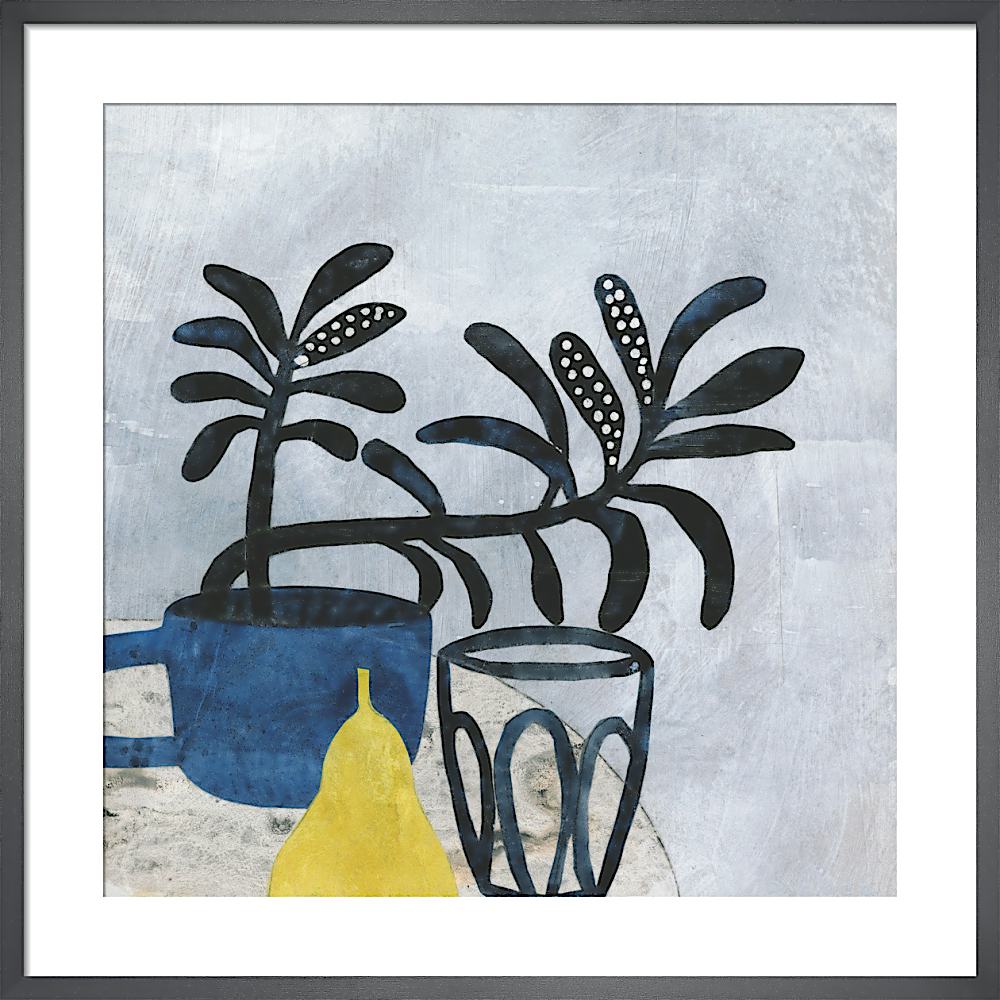
A: I honestly find awe in the mundane! I love that I can take something as ordinary as a few glasses on a table and project my own lived experience through colour, marks and composition. Art really is story-telling via imagery. The kids might have a documentary about spiders on in the background that will work its way into my art. Or a simple reflection might create a colour that I try to recreate. I love capturing a snapshot of everyday life, and still life really is a beautiful way to interpret the everyday moments into materialised packages of self-expression, in the hope that it might just bring joy into the life/home of somebody else! This really is the fuel for making!

Q: Could you work us through your creative process - how do your ideas typically evolve from concept to finish?
A: I like to imagine my creativity has its own orbit which pulls me in certain directions depending on where life's at. Sometimes that might mean I work with textiles or perhaps it's a painting week, or a printing day. I just choose to work on whatever keeps me at peak enthusiasm thus avoiding creative blocks and excessive procrastination. It’s probably its own form of procrastination but at least it’s productive and channelling an unforced energy into my work.
Play is the key to getting started! I’ll often arrange my painted papers into lovely colour groups. I might sketch and cut out some shapes and usually that will be enough to get ideas rolling. The rest will usually happen organically through a state of flow. My immediate surroundings will be absorbed (quilts, documentaries, arguments, gardening etc.) turning them into background motifs, marks and symbols in my work.
My process is rather long. Beginning with collecting recycled papers, painting them, illustrating shapes, cutting shapes, arranging them (sometimes for hours), I often take space from the piece to see it with fresh eyes, enabling me to move forward with it, then patiently gluing them and sealing the art. Naming the work usually happens at some point during the process. This is a very simplified breakdown of how a piece is made. It mostly follows this pattern somewhat.

Q: Finally, what are you working on currently?
A: I'm just finishing up on a commission, personalising it with marks and motifs relating to my client. After that I will be giving my first classes in block printing. Next in the pipeline are a few pieces for Australian company Fenton and Fenton, and my first open studio in October, with Banyule Open Studios.



Related stories
 spotlight
Meet Bianca Harrington
spotlight
Meet Bianca Harrington
Reading time: 4 mins
Join us in conversation with Bianca as she reflects on her journey through textiles and millinery, her ability to find awe in the everyday, and her plans for the future.
 spotlight
Meet graphic artist Nick Cranston
spotlight
Meet graphic artist Nick Cranston
Reading time: 2 mins
Join us as we talk to Nick about his artistic practice and his collection of graphic prints, available exclusively with K&M.
 spotlight
Works in series
spotlight
Works in series
Reading time: 1 min
Transform your walls with a curatorial touch. Our Works in series collection brings together compelling, cohesive artwork sets – each handpicked by our in-house experts for their narrative strength.
 spotlight
Our team’s favourite artworks
spotlight
Our team’s favourite artworks
Reading time: 2 mins
Each month we ask a member of the K&M team to share their favourite artwork and the reasons why they love it so much. Here’s our latest roundup.
 spotlight
Exhibitions to see this summer
spotlight
Exhibitions to see this summer
Reading time: 3 mins
Discover the exciting exhibitions opening this summer at The Courtauld, National Portrait Gallery, Tate Modern and many more.
 spotlight
Meet Artist Residence Founder, Charlotte Salisbury
spotlight
Meet Artist Residence Founder, Charlotte Salisbury
Reading time: 3 mins
To mark our partnership this Summer, join us in conversation with Charlotte Salisbury - Founder of the Artist Residence boutique hotel group - as she shares her unique approach to interior design, the story behind collecting artwork for each of her hotels, and the rich history that inspired the name Artist Residence.
 spotlight
We catch up with Yoni Alter
spotlight
We catch up with Yoni Alter
Reading time: 3 mins
We catch up with Yoni to to discuss his broad, experimental, playful oeuvre that ranges from spray paint and printmaking to small scale sculpture and large scale public art.
 spotlight
Fender’s electrifying ‘You won’t part with yours either’ campaign
spotlight
Fender’s electrifying ‘You won’t part with yours either’ campaign
Reading time: 2 mins
Discover the history behind Fender’s early beginnings, from the revolutionary amps and guitars invented by Leo Fender, and Robert Perine’s compelling campaign that helped Fender grow from a small town company to a music industry leader.
 spotlight
Projekt 26: Sylwia shares what she loves most about our latest release of Polish posters
spotlight
Projekt 26: Sylwia shares what she loves most about our latest release of Polish posters
Reading time: 1 min
Proud custodian of Polish design heritage, Sylwia of Projekt 26 shares what she loves about the latest designs to join our limited edition collection and the artist’s behind them.
 spotlight
Meet contemporary painter, Marta Chojnacka
spotlight
Meet contemporary painter, Marta Chojnacka
Reading time: 3 mins
We talk to Marta about her artwork’s inescapable optimism, her vibrant palette inspired by the flora and sunlight of Barcelona, and daily creativity.
 spotlight
Highlights from Affordable Art Fair, Hampstead
spotlight
Highlights from Affordable Art Fair, Hampstead
Reading time: 1 min
A photographic roundup of our weekend exhibiting at Affordable Art Fair Hampstead, featuring the limited and original artworks on our stand, as well as views from around the fair.
 spotlight
Meet Meg Gage Williams, founder of The Archives Design Group & Stick No Bills
spotlight
Meet Meg Gage Williams, founder of The Archives Design Group & Stick No Bills
Reading time: 6 mins
Learn how Stick No Bills grew into a company with flagship galleries around the world and the artists behind the BOAC advertisement posters that we are thrilled to present as fine art prints.
 spotlight
Ukiyo-e: Hokusai, Hiroshige and Kawase’s idyllic Japanese landscapes
spotlight
Ukiyo-e: Hokusai, Hiroshige and Kawase’s idyllic Japanese landscapes
Reading time: 2 mins
An ancient technique dating back to 7th century Buddhist monks, Ukiyo-e woodblock printing became a popular medium in Japan’s Edo period that all levels of society could afford. Discover the lives and art of three master Ukiyo-e artists whose works are still revered today.
 spotlight
We catch up with Faye Bridgwater
spotlight
We catch up with Faye Bridgwater
Reading time: 6 mins
We sit down with K&M contemporary artist Faye Bridgwater to learn more about her involvement in Saatchi Gallery’s exhibition ‘Flowers – Fauna in Contemporary Art & Culture’, judging at the Guildford House Open Call and once again displaying her joyful paintings in this years’ Artists Open Houses in Brighton.
 spotlight
Affordable Art Fair Hampstead, 2025
spotlight
Affordable Art Fair Hampstead, 2025
Reading time: 3 mins
We are excited to announce that we will be exhibiting at the Affordable Art Fair, Hampstead this May. We will be showcasing limited editions and original artworks by 15 of our contemporary artists including Nigel Hall RA, Liz West and Marc Quinn.
Subscribe to our newsletter
Be the first to hear about our new collections, limited edition launches, and enjoy artist interviews.
By subscribing you agree to our privacy policy.
Contact us
01273 511 942
Mon-Thurs, 9 am - 5 pm
Fri, 9 am - 2 pm
All art prints and images on this website are copyright protected and belong to their respective owners. All rights reserved.